Gas Suppression Systems
Clean agent fire protection
WHO WE ARE
ESTABLISHED
1979
Fire protection engineers with decades of trusted experience.
SAQCC
CERTIFIED
Qualified technical staff on every installation and service call.
COUNTRY
WIDE
Nationwide projects and installations across South Africa.
FULLY
EQUIPPED
Central Durban base with a complete workshop and support team.
TRUSTED
EXPERIENCE
Major banks, hospitals, retail and government clients.
Gas Suppression Systems
Clean agent and inert gas systems for server rooms, archives and sensitive equipment protection.
Overview
Gaseous fire suppression is a term to describe the use of inert gases and chemical agents to extinguish a fire. Also called Clean Agent Fire Suppression. These agents are governed by the NFPA Standard for Clean Agent Fire Extinguishing Systems — NFPA 2001.
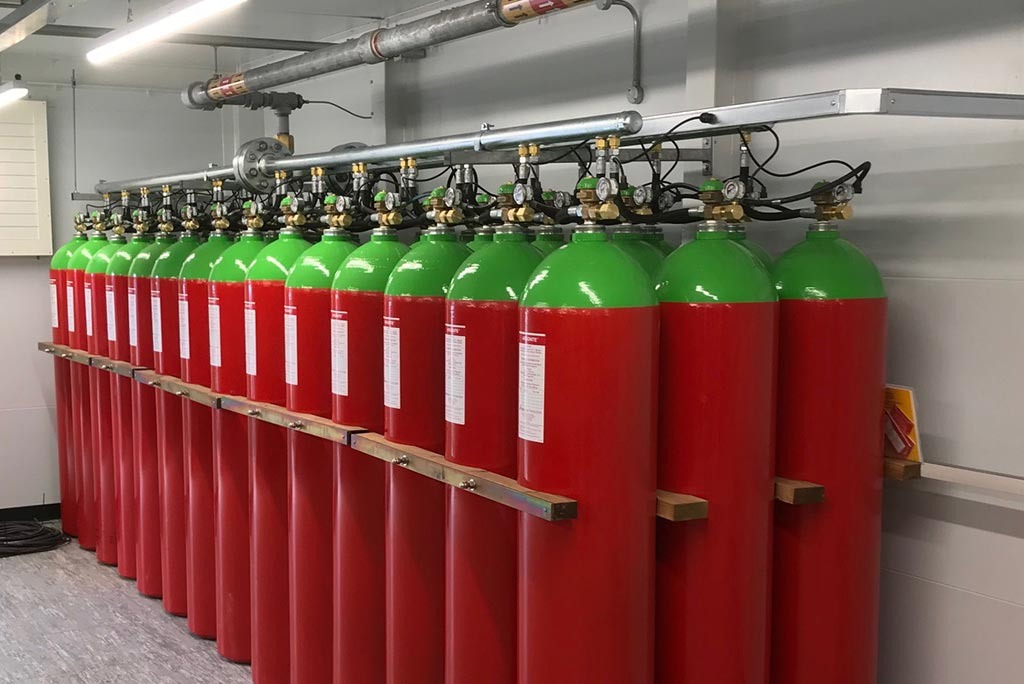
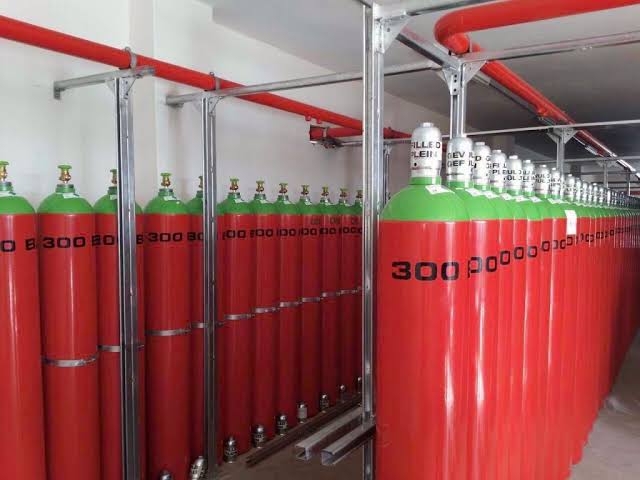
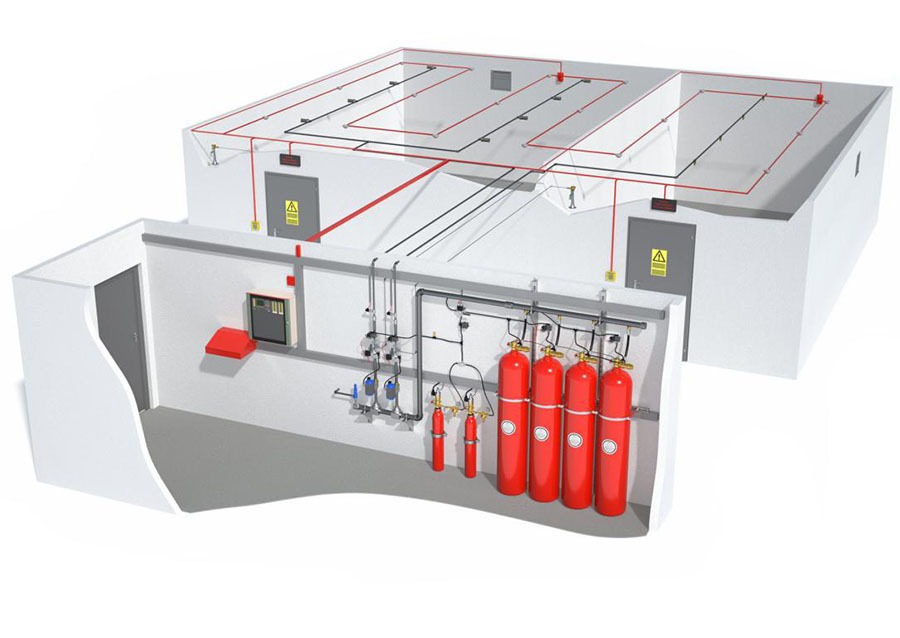
The system typically consists of the agent, agent storage containers, agent release valves, fire detectors, fire detection system (wiring control panel, actuation signaling), agent delivery piping, and agent dispersion nozzles. Less typically, the agent may be delivered by means of solid propellant gas generators that produce either inert or chemically active gas.
The Fire Tetrahedron
There are four means used by the agents to extinguish a fire. They act on the "fire tetrahedron":
Reduction or Isolation of Fuel
No agents currently use this as the primary means of fire suppression.
Reduction of Heat
Representative agents: HFC-227ea (MH227, FM-200), Novec 1230, HFC-125 (ECARO-25).
Reduction or Isolation of Oxygen
Representative agents: Argonite / IG-55 (ProInert), CO₂ carbon dioxide, IG-541 Inergen, and IG-100 (NN100).
Inhibiting the Chain Reaction
Representative agents: FE-13, FE-227, FE-25, MH227, FM-200, Halons, Halon 1301, Freon 13T1, NAF P-IV, NAF S-III, and Triodide (Trifluoroiodomethane).
Application
Broadly speaking, there are two methods for applying an extinguishing agent: total flooding and local application.
Total Flooding
Systems working on a total flooding principle apply an extinguishing agent to a three dimensional enclosed space in order to achieve a concentration of the agent (volume percent of the agent in air) adequate to extinguish the fire. These types of systems may be operated automatically by detection and related controls or manually by the operation of a system actuator.
Local Application
Systems working on a local application principle apply an extinguishing agent directly onto a fire (usually a two dimensional area), or into the three dimensional region immediately surrounding the substance or object on fire. The main difference in local application from total flooding design is the absence of physical barriers enclosing the fire space.
In the context of automatic extinguishing systems, local application does normally not refer to the use of manually operated wheeled or portable fire extinguishers, although the nature of the agent delivery is similar.
Safety Considerations
Suffocation
Systems using certain agents, such as carbon dioxide, in enclosed spaces present a risk of suffocation. Numerous incidents have occurred where individuals in these spaces have been killed by carbon dioxide agent release. To prevent such occurrences, additional life safety systems are typically installed with a warning alarm that precedes the agent release. The warning, usually an audible and visible alert, advises the immediate evacuation of the enclosed space. After a preset time, the agent starts to discharge. Accidents have also occurred during maintenance of these systems, so proper safety precautions must be taken beforehand.
Barotrauma
The positive pressure caused by extinguishant release of the inert agents in this group (IG-541, IG-55, IG-100) may be sufficient to break windows and walls. Humans and structures must be adequately protected.
Project Gallery